Tuesday, June 22, 2010

Top 100 Films - 20

20.

I was late to the Lebowski party, having somehow carried on an existence without it up until my freshman year of college, when I first joined the Dude, Walter and Donnie on their neo noir odyssey across Los Angeles. Over the next 12 months, I lost track of how many times I revisited this, compulsively converting new followers and experiencing it on a whole new level over many a delicious White Russian. It wasn’t until sometime later that I was able to get over my cult like fascination with the movie and do something I never thought to do – take it seriously.

And I don’t mean to suggest that The Big Lebowski should be so burdened with analysis that it becomes impossible to kick back and watch the hilarity of it all ensue. But dammit, this is a brilliant film, delivering nothing short of comic gold while adapting the trickiest of genres – noir – to the slacker culture of early 90s Los Angeles. When Jeffrey “The Dude” Lebowski’s rug is soiled after a case of mistaken identity, he embarks on a quest for reimbursement that spirals into a convoluted Raymond Chandler style plot that deceptively drives The Dude further off course as the clues, characters and car troubles escalate to the extreme. So it’s a neo-noir comedy, but it also takes cues from Westerns (hence the presence of Sam Elliot in cowboy gear) and Busby Berkeley musicals (The Dude’s porno hallucination) and you could even argue it’s a historical piece (set against the backdrop of The Gulf War). The cast consists mostly of memorable cameos, oddball characters that drop in to make The Dude’s life more complicated only to prove unimportant no matter which way you look at things. But for that we get Ben Gazzara as slick porn mogul Jackie Treehorn, David Thewlis as the literally hysterical Knox Harrington, Joe Polito as meddling snoop DaFino, and John Turturro as the one and only The Jesus. Even the more significant supporting players – Julianne Moore as the icy Maude Lebowski, Phillip Seymour Hoffman as loyal lapdog Brandt, the band of nihilists lead by Peter Storemare – prove nothing more than diversions from the real solution. But then again, if all these characters don’t really factor into any grand scheme, at least they provide The Dude with a reason to get out of the bowling alley, and in one case, out of the bathtub.

I can’t believe I’ve gone so far without singling out Jeff Bridges, but he embodies The Dude like only an actor of his ease could do, and truly he’s what ties the film together. Playing perfectly off his passive approach to life is John Goodman as bowling buddy and ‘Nam vet Walter, and along with their more diminutive teammate Donnie, they form the core of the movie, with the bowling alley being the one constant in The Dude’s suddenly upturned life. In that way, the film does set itself apart from noir, for although The Dude is as unlikely a hero as there ever way, he has his close friends, who despite their flaws, are there with him to the bitter end. And ultimately, as the film draws to a close, we understand at last that those are the bonds that mattered the most to The Dude, and this whole charade that started with one ruined rug wasn’t worth one night in the bowling alley.

Monday, June 14, 2010

Top 100 Films: 25 - 21

25.

Writing this now, a full year after I first devised this list, makes me realize just how far my tastes have come even in that short time. Here I’ve got Michael Powell and Emeric Pressburger’s glorious story of the rise and fall of a perpetual old soldier at the tail end of my top 25 films, but it could just as easily have been The Red Shoes, Tales of Hoffman, or my earlier entry Black Narcissus. Hell, they all could have made it. I’m increasingly convinced that these guys were the greatest directors to ever work in the medium. I know Martin Scorsese agrees.

But I’m sticking to the original plan, and for now it’s just The Life and Death of Colonel Blimp here. It’s a wartime film made during wartime, boldly grappling with the state of the British military as it pits the old dog Clive Wynne-Candy against a younger generation of military men, no longer bound by the honor and tradition bred into him from his earliest years of service. Major General Candy is the hero, albeit a foolish one, but it’s impossible not to admire his convictions, which play an integral part in establishing the great friendships and loves of his life. Roger Livesey gives a towering performance in the central role, but no less impressive is the support from Anton Walbrook and Deborah Kerr, the later leaving her mark on three different roles. It’s the strongest story that the Archers (Powell and Pressburger’s production company) ever put together, which is saying a lot, and the larger than life characters, stylish direction and triumphant score leave you wanting little else.


24.

Picnic at Hanging Rock holds a special place in my heart for so elegantly tearing down the walls of the oft-clichéd mystery genre and showing me just how much mileage you could get out of a perfectly crafted enigma. It was hardly the first film to do this, and perhaps had I seen L’avventura first, I would have instead latched onto that, but since it was Peter Weir’s film that I first came upon, it’s remained an essential one for me ever since. Like L’avventura, the first act of the film ranks among the most deliriously beautiful pieces of cinema I’ve ever seen. At the outset I felt letdown that such a pace couldn’t be sustained, but after a third of the film devoted to weaving a haunting tale of disappearance when a group of young girls venture up to the peak of the temporal curiosity that is Hanging Rock, we get to dwell in those interminable days post catastrophe with the classmates and teachers they left behind, and it’s only at the end of all this that the film seems to truly have set itself apart. We’ve been fed a steady stream of clues, suspects, and bizarre occurrences, but never do we come closer to the answers we were initially looking for. And by that point, we really don’t care, something that diehard Lost fans should appreciate.

The point is that sometimes the uncanny is better left without explanation. There’s nothing scarier, nothing more haunting, than the unknown, and solutions (satisfying or not) often devalue the mystery that came before them. And with a mystery as elegantly construed as this one, we’re better off left to wonder.


23.

Nashville, despite a Best Picture nomination, a slot on the AFI top 100 and the general consensus as Robert Altman’s best film, still feels grossly underrated. For that I can think of a few explanations, though not a one feels like a valid complaint. Sure it’s long, but not Lawrence of Arabia long, and there’s a real momentum behind every event, driving every member of the sprawling ensemble toward the fateful concert that will at last bring them all together. It’s also about grass roots politics and country music, and I can personally sympathize with any aversion to these, but it all works, a uniquely American genre of music and a slice of democracy actually at work among the people, woven among the cast of dozens without a single lead, altogether the most American movie I’ve ever seen. Dreams are both realized and shattered, love is discovered and hearts are broken, and people find strength in each other, but also in music. In a way, it tells the story of America without ever attempting to project that onto one individual or family. The many characters of Nashville form a more honest cross-section of the country, and the story doesn’t belong to any one of them, but all of them. Presented this way, it understandable doesn’t fit our anticipated mode of storytelling, but it never feels disconnected and the characters are fascinating to observe, and it all ties together in a landmark finale that’s among the most powerful there ever was. Underrated indeed.


22.

A curious adaptation of one of Shakespeare’s finest works, Prospero’s Books is almost more of a multimedia experience than a film. Mad genius Peter Greenaway directs everything as if it were on the world’s largest stage, only to divide our attention through artful overlaid images, just some of the examples of his frame within a frame (which occur both naturally, and through post production). The ancient John Gielgud plays Prospero, truly standing in for the bard himself as he recites the lion’s share of The Tempest as the events unfold onscreen. It sounds complicated, but the film is anything but manic, thanks mainly to the elegant gliding camera of Sacha Vierny. It also may just be the most artistic film I’ve ever seen, committed to raising the level of literary adaptations above simply illustrated text and creating in the process something both truly cinematic and at harmony with all other forms of art. Call it pretentious if you like – I call it beautiful, every word of the play, every note of the score, and every frame upon glorious frame.


21.

Bernardo Bertolucci remains more famous for the scandalous Last Tango in Paris, but his earlier masterpiece The Conformist has all the style and all the sex of that one just without the butter. It’s an intense political thriller that doesn’t mind damning its main character, Marcello, and we stick with him all the way anxious to see whether he is capable of mercy or he’s been conditioned as nothing more or less than a fascist assassin. Jean-Louis Trintignant in perhaps his definitive role has all the cool aplomb of Alain Delon in Le Samourai but his fascist ties severe much sympathy for him, though the film is gracious enough to explore childhood trauma crucial to his development. This only draws us closer to those around him, those who may feel the consequences of his actions, and sure enough the supporting ladies, Stefania Sandrelli and Dominique Sanda, figure prominently into many of the film’s greatest scenes. And there’s no shortage of great scenes here, though the very finest may be the dance hall, where Marcello finds himself consumed by the crowd, and Bertolucci gets a chance to pay homage to the other great Italian political epic, The Leopard.

Sunday, May 2, 2010

Top 100 Films: 30 - 26

30.

A swan induced car crash sets the scene for one of Peter Greenaway’s most outrageous films (and that’s saying a lot). See, the crash claimed the lives of two sisters, wives of twin zoologists engaged in the most morose experiments imaginable, but there was one survivor, an enigmatic woman soon to be an amputee. And as only Greenaway could conceive, the twins strike up a steamy ménage a trois with the legless seductress, all while taking their experiments to staggering new heights. Strictly on that plot description you ought to know if this film is for you. Clearly my threshold for the perverse is through the roof, if not blown to smithereens thanks to a few too many viewings of Pink Flamingos, but A Zed and Two Noughts is art porn at its most intellectual. The unstoppable collaborative force of Greenaway, cinematographer Sacha Vierny, and musical impresario Michael Nyman assaults the senses, most shockingly with frequent time-lapse snapshots of biological decay. The score in particular is unrelenting, ceding on occasion to the unsettling tune of “The Teddy Bear Picnic” which at that point ceases to be the whimsical children’s tune you once knew it as.

It’s understandable where such a film can go wrong for people. Greenaway is guilty of just about every charge leveled against him; pretension, indecency and ostentatious staging, and he hones these qualities into a very distinct, often off-putting aesthetic, but to allow yourself to be turned off too quickly misses the point. His aim is not to corrupt, not even to revolt, but to most seriously consider ideas ranging the whole intellectual spectrum from politics to art to science. A Zed and Two Noughts is his most scientific film, and perhaps the oddest condemnation of Creationism there ever was. Yet the film doesn’t stoop so low as to hammer a thesis over your head. Rather, omnipresent themes form pieces in a meticulously crafted puzzle, and from the images of primal lust, sanctimonious megalomania and decay (both human and animal), we’re free to draw our own conclusions. Its considerable influence on David Cronenberg’s Dead Ringers is impossible to overlook.


29.

The New World plays best when viewed on as large a screen and in as intimate a setting as possible. It’s the kind of film where from the moment it starts, you forget everything around you and form the most organic connection to its simple story and lyrical images. And some of those things you forget will remain forgotten, the stigma, for instance, that you’ve no doubt built up against Colin Farrell (because he’s tremendous here); or the way you view romantic epics (because I unabashedly love them, and not a one stacks up to this); and if you’re really lucky, any lingering memory of Disney’s borderline offensive attempt at the Pocahontas story in the middle of what was otherwise their greatest decade. You can forget those things, but you’ll be hard pressed to forget the overwhelming beauty of The New World, nor the unfettered performance of Q’Orianka Kilcher.

Terrence Malick outdoes himself in every way possible. Yes, it’s a better looking film than even Days of Heaven, which is also to the credit of Emmanuel Lubezki and his ever graceful lens, but Malick’s touch is all over this. The pace is perfectly measured, quickly and effectively bounding through the necessary historical milestones and dwelling at length on the quiet moments – the struggles in communication, the communion with nature – that amount to a romance stronger than amorous dialogue and saccharine scenes can deliver. For a historical epic, romantic variety or not, the plot is surprisingly stripped down. Simple, but it hits. And the film has no greater asset than Kilcher. Her performance stands as my second favorite of the decade, partly for how effortlessly she commands the screen (and the attention of everyone within it) and largely for giving life to a character who otherwise could have came off like any number of historical performances –the ones that contain the depth of a few paragraphs in a text book. In her, Malick found perhaps the one person radiant enough to feel at ease in his gorgeous cinematography. From Kilcher and Farrell to the set and score to the scope of the whole thing, he orchestrates it so naturally, making The New World one of the unqualified masterpieces of the aughts.


28.

Orson Welles, the precocious conjurer of cinema, pulls his greatest feat not in one of his own films, but in Carol Reed’s model noir The Third Man, as he assumes the role of enigmatic Harry Lime and with a flash of light, a Cheshire cat grin and the obstruction of a passing truck, elevates him to the pantheon of legendary screen characters. Lime’s out of the shadows entrance is the grandest ever captured on film, wholly earned after nearly half a film spent building the myth of this crime king of Vienna, the titular third man. And he’s not merely a plot device; he’s a fascinating creature living by his own moral code, fully understood in his conversation with Holly Martin’s atop the Ferris wheel, a scene which can’t help but evoke the idea of the Devil tempting Christ from a cliff overlooking Galilee. Lime’s screentime is limited, but his feline shadow hangs over every frame of the film, long before he even enters the picture. And apparently not content with having made the grandest entrance ever, he bows out in no less memorable a fashion.

But it would be an egregious oversight to accredit all the film’s success to Welles. Reed, sadly shown little affection aside from this readily embraced masterpiece, makes a series of bold decisions that pay off most remarkably. The crooked cinematography of Robert Krasker most obviously sets the film apart, harking back to noir’s roots in German Expressionism only without the twisted stage sets. Vienna seems all the more dark and disorienting when viewed at an angle, and like Holly we feel as though our world has been turned upside down. Second is that unshakable zither score, composed by Anton Karas who Reed came upon as the film was in production. But virtually everything here works just as well as these showier elements, from a string of terrific performances (not the least of which is Joseph Cotton as the hapless Holly) to the impeccable lighting design. It’s a rare perfect picture, which isn’t even something I would say about most films ranked even higher on my list, and I’m always ecstatic to find myself in total agreement with a film’s reputation. One of the great British films in a decade overflowing with them.


27.

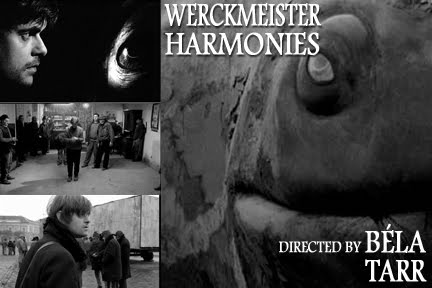
Belá Tarr seems a spiritual successor to the great Andrei Tarkovsky, his bleak (never brief) meditations on life and faith evoking a pervasive central Eurasian atmosphere while always finding a certain grace – hell, let’s call it art – in these surroundings. The marathon that is Satantango calls more attention to itself on running time alone, but it’s the more recent Werckmeister Harmonies that contains Tarr’s greatest accomplishments. There’s that magic number, 39, the number of shots that comprise this two and a half hour film, and the number of those shots that go down in the film history books is staggering. The opening scene sets the bar high, a slow burn stroke of poetic staging in a dreary Hungarian pub. That’s before the circus rolls into town, bringing with it a gargantuan whale carcass, a mystical and dangerous prince, and forces of chaos biding their time before turning this sleepy Eastern European town into a hotbed of unrest and upheaval. In the film’s most extraordinary scene – and by scene I mean single shot – the main character flees down a desolate street soon to be overrun by a gathering mob. It’s a trying couple of hours, but the reward is one of the unshakable haunting visions of cinema; a masterpiece that could belong to any decade, but being so recent seems proof enough that film as art is far from dead.


26.

Justifying my affection for 80s animation is not such an easy task, but there’s a murky aura surrounding the design, and especially the soundtracks, that makes some of the shining examples feel all the more epic (Akira, Gandahar, The Black Cauldron, The Secrets of Nimh, Castle In the Sky, The Great Mouse Detective, Ralph Bakashi’s Lord of the Rings). Though I wouldn’t necessarily claim the superiority of these over the more polished 90s animated fare, they’ve nonetheless got something those later films are in want of, and since I’m a child of the 90s, I don’t think it’s nostalgic value. Maybe it’s the lack of musical numbers, or perhaps the darker tones that hang over the worlds of these films, but his highly atmospheric age of animation makes a fascinating era to look back on, one that seemed to die upon release of The Little Mermaid, never to return.

The best of such films is Nausicaa of the Valley of the Wind, the film that put grandmaster of animation Hayao Miyazaki on the map, and established many of the themes he would continue to explore throughout his career. Nausicaa is the most perfect of all Miyazaki creations (not perfect as in best-conceived character, but as in quite literally without flaws – she is remarkably brave, deeply empathetic and impossibly beautiful) which might make her less interesting were this a character study, but it’s a sweeping fantasy adventure of the grandest order and Nausicaa is nothing less or more than a heroine we want to cheer on.

It’s also simply gorgeous to look at. Miyazaki creates an entire planet’s ecology long before James Cameron got to fooling around with his new-fangled computer program and from crystalline caverns to poisonous forests to the tranquil valley where Nausicaa hails from, an entire world is captured in one glorious frame after another. Such imagery is paired with Joe Hisashi’s equally surreal and luminous score, its haunting synth sounds justification for a decade’s worth of cringeworthy applications of such techniques, and both the grand swell of the main theme and the eerie chant on the forest air being among the more beautiful compositions ever created for film. Miyazaki revisited many of the ideas here in Princess Mononoke with great success, but even then he couldn’t quite recapture the overwhelming feeling of pure adventure that he created here.

Top 100 Films: 35 - 31

35.

Seldom do we get such honest depictions of childhood on film as Victor Erice’s sublime The Spirit of the Beehive. A Castilian family during the Second World War lives without much thought to the conflict consuming their continent. The father tends to his bees and the mother to her letters while the two young girls explore the surrounding countryside and crowd into a makeshift theater for weekly movie screenings. So it is that young Ana – ever curious, ever fascinated – first views James Whale’s classic Frankenstein and becomes consumed with the presence of the monster lurking nearby. She finds him eventually, at least as far as she is concerned, a wounded soldier lying low in an abandoned farmhouse, and tends to him with an unbiased empathy as only a child could. All this unfolds like a delicate survey of the world through a child’s eye, which isn’t to say that adult themes aren’t ever present, they just aren’t worthy of the attention of a seven year old. What we get is a film of immeasurable beauty and fascination, the crowning achievement of Spanish cinema.


34.

Nestled next to just about anything on this list, Daisies was bound to play the part of the sore thumb. It’s relatively short, barely over an hour; born out of one of the more unlikely cinematic Renaissances, the Czech New Wave; and a landmark in both experimental and feminist filmmaking. But it’s also a glorious madcap romp that taps into the spirit of the 60s in a way virtually no other film quite manages. Two young girls embark on a subversive odyssey that will have them blithely waltzing across a world where menfolk simply don’t know what to do with them, culminating in a banquet scene that knows no bounds, as the phantom ladies swing from the chandeliers and bring down the house. Adding further to its allure, Daisies lays the groundwork for not one, but two films I consider among the greatest of all time, which means, I suppose, that I owe this little flight of fancy much thanks.


33.

Fritz Lang may have single-handedly opened to me the vast library of canonical films with his killer one-two punch of Metropolis and M. The majesty of the former is hard to dispute, and I was at first reluctant to believe that M was the better film still, but I came around pretty quick. What makes it so damn perfect is how it almost immediately subverts all expectations; that somehow being black & white or foreign or older than Larry King somehow makes a film less engaging, or that a nearly 80 year old film can’t face controversy head on. Well the main character here is a pedophiliac, child murdering Hans Beckert (given sniveling life by the one and only Peter Lorre), scourge of the small town and current public enemy number one, wanted by both the police force and the seedy underground suffering from the amped up security on his behalf. So both groups make a play to capture Hans and a thrilling showdown in a locked down building leads right into a horrific trial in which we find ourselves thinking the unthinkable, that perhaps this despicable man isn’t getting the justice he deserves. All these years later its bold vision hasn’t diminished, and in the not-so-daring current era we’re in, it feels all the more refreshing.


32.

Ah, 2046, I feel I only just quite adequately summed up my fondness for you in compiling my favorite films of the 2000s, and so rather than attempt to rehash what I already went on record with, I’ll merely repost my review from a few months back. I’ll add to it the note that in those interim months, I had caught up with a few other Wong films (Days of Being Wild and Ashes of Time Redux) and feel even more vindicated in putting two of the guy’s films in my top 50. He’s truly one of the greats.

If In The Mood For Love is Wong Kar Wai’s La Dolce Vita, then surely 2046 is his 8 ½. After all, it’s certainly the most stylish film centered on a creative genius in the 1960s balancing the women in his life with his science fiction epic in progress since Fellini’s masterpiece. And until writing that last sentence, the similarities between the two had never seemed so apparent.

It had never occurred to me to consider 2046’s merits as an homage since I’ve always been more fascinated by the unique temporal lens through which it comments on the most peculiar state of the city, the great city of Hong Kong. That’s been a defining characteristic of Wong’s filmography, and twice now he’s rocked cinema with a film that bottles up the spirit of the city, with Chungking Express in the years prior to the 1997 turnover from British hands, and then a decade later with 2046, under ever-evolving political circumstances.

The numbers mean everything in the world. A brief history lesson: British relinquish control of Hong Kong to China in 1997, launching a 50 year period of gradual transfer to Chinese governance. The deadline, 2047, which means the titular date marks the final year in which Hong Kong legally retains something of its old identity. It’s a date always on Wong’s mind, and here it looms in an enigmatic science fiction story evolving from the mind of a 60s writer, one we’re already familiar with from In the Mood for Love. That makes it a film made in the mid 00s, set in the 60s, with visions of an uncertain future constantly on its mind. For Wong Kar Wai, that sounds about right.

And before I burn myself out digressing on the intellectual euphoria 2046 sends me into, I’ve got to make mention of just a few of the other things that are going so right here. If asked what I thought the sexiest film ever made was, this would be my runner up (marginally behind The Unbearable Lightness of Being) because it knows how to latch onto finer details and use them to elicit desire. It’s a stylization of fetishization, much in the way Mad Men often is, and the camera dwells at length on wisps of smoke, mysteriously gloved hands, shoes sliding back and forth across the hardwood floor. Passion simmers in these moments, building towards the elegant sexual release of each romantic tryst. And if you think can imagine how good it all looks, just wait till you hear how it sounds. The pulsating score will pull you into a symphonic spiral that carries you from the 1960s to the distant future and back again. Then there’s that cast, lead by the incomparable Tony Leung, who, like Guido Contini and Joe Gideon before him, is defined by the women in his life. They come in the form of Zhang Ziyi and Faye Wong, of Gong Li and Maggie Cheung, and they’re equally mysterious, romantic, compelling and, to be totally superficial, remarkably beautiful. And if that’s not enough reasons to watch, then I’m confused why you’ve read this far.


31.

Red Desert is a film of many surprises. For this viewer who never fully bought into Antonioni’s greatness (sans L’Avventura that is) I was blindsided by a film both meditative and evocative in a way I was seldom used to. Like Fellini’s Juliet of the Spirits, Antonioni’s first foray into color is among the best uses of the palate the medium has ever seen. In both films, there seems to be a need to justify the use of such color, and Red Desert would certainly have imploded in black and white. Color here is absolutely key.

And yet that color is muted to positively dreary effect (in stark contrast to Juliet) but that is the reality of the industrial landscape Monica Bellucci makes her life in. It’s a rust colored wasteland peppered with dead grass and dark smoke and even the sexual highlights of such an existence ultimately seem mundane against the ever-present backdrop. Until out of nowhere Antonioni pulls the most entrancing trick. As Bellucci relays a bedtime story to her son, we’re whisked off to the most tranquil seascape imaginable, a picturesque beach that teems with vivid color, washing away the oppressing imagery of mills and factories. Like the child, we’ve been granted a reprieve from a none-too-inspiring reality, and Antonioni graciously gives us ample time to bask in to beauty of this insulated world before closing that chapter of the film and forcing us to face once again a life we thought – or maybe just hoped – we had at last escaped. The segment ranks among the greatest moments in all cinema and it goes down like nectar compared to the rest of the film, yet without such exquisitely mounted contrast it could never have achieved such effect.