Crafting a list of 31 is easy. It's just long enough to fit in all the concessions you would possibly care to, and yet the total number of entries is small enough to be fathomable. Meaning, your list doesn't appear so exhaustive that an omission (intentional or otherwise) is offensive. I could have easily gone to 50, and a slew of other classic numbers would have reared their fabulous heads, but that's just more reviews, more justifications, and more time stalling before the grand spectacle of any "Best" list, the Top 10.
And Top 10s are hard. Lemme whip up a fancy analogy here and say it's not unlike creating a signature recipe. There's not necessarily a right or wrong way to make a dish delicious, but certain ingredients help, and there's nothing quite like concocting something they've never tasted before. And in being unique, you often have to go a ways out on a limb, and yet there still has to be something cohesive about the whole thing, otherwise it just won't taste right. End lame metaphor.
Where was I? Right, griping to myself about the significant mental anguish I expended for the sake of this neatly package Top 10. Is it diverse? To a point, although seven of the ten entries come from within two decades. And four of those seven are divided (by decade, naturally) between two directors. That points rather definitively toward my preferences as a film-lover, specifically my longstanding status as an Auteur Theory bannerman. And while I usually vehemently deny any bias against contemporary films, there is some truth to that within the genres where the peak productive periods exist in days gone by. This would cover westerns, noir, epics, and of course, musicals.
And yet, I do consider this an exciting, even eclectic mix, with nearly 50 years between the earliest entry and the latest, some of which have directly beget others within these ranks. All are pivotal in one way or another to the history of the medium, or at the very least the genre, though as many as three of these will strike the musical purist as unfair play. But I'll leave the justifications for a little later down the line. For now, let me proudly present:
10. "Remember My Forgotten Man" from Gold Diggers of 1933
Musicals rose to prominence in the 30s because they were the ultimate form of escapism: wild, joyous fantasies that allowed audiences temporary reprieve from the ever-present Depression that was consuming them. Busby Berkley was the grandmaster of such spectacles, and yet here, in a musical that includes the oft-cited Depression classic "We're In The Money," the film closes its curtain on a number that forces audiences to reflect not only on their current sorry state, but specifically on the inelegant fall of veterans of the Great War in these lean times. To put it mildly, it's kind of a downer.
Well, as far as musicals go, that is. I'd be hard pressed to think of a song with a stronger build to it, mounting on Joan Blondell's poetic lament until it reaches the astonishing closing setpiece. It's the kind of song that sends chills down your spine, and with years removed now from the immediate critique present in the song, it feels no less effective, just less personal. That makes it a rare musical number that deals with a social issue, and rarer still, one that feels relevant for when it was (oh, silly Hairspray, you untimely thing you). Considering also, that the haunting music is one of the great tunes of classic Hollywood, "Remember My Forgotten Man" earns its lofty place on this list no problem.
Next, for those familiar with my tastes, the least surprising inclusion on this list:
9. "Bye Bye Life" from All That Jazz
I'm gonna repeat this again, All That Jazz is the high point of an entire genre, the last bona-fide masterwork in the history of movie musicals, and as I'm bound not to let you forget, the greatest of them all. Opinions differ, but packed in here is everything there is to love about musicals. Yes, it's relentlessly self-indulgent, but if you have any affection for this most self-indulgent of genres, then you'd better be used to that by now.
Why I chose "Bye Bye Life" shouldn't mystify anyone. Few films have drawn to a close on such a spectacle as this, a song and dance farewell to the mortal coil on an ethereal stage that could only have existed between 1977 and 1980 AD. Central to it all is Roy Schieder, wrapping up the performance of his career and proving that actors in musicals can mine real emotional depth from their roles. Lending ample support is the one-of-a-kind Ben Vereen, who would probably also be my choice to MC my last moments on earth.
So the song ends up being by turns surreal and spectacular, devastating and divine. Were it not for that chilling endcap, I might request this played via video projection at my funeral. But those last two seconds are just so frighteningly...final...that it might be viewed in bad taste. Well, considering this essentially prophesied Bob Fosse's own impending exit from the stage of life, that only makes this all the more unnerving.
Upswing, Fosse will always live on through my eternal listing. Small consolation, you say? Well I say Fred Astaire never found it in him to complain...
8. "Girl Hunt: A Murder Mystery in Jazz" from The Band Wagon
Poor Fred Astaire was one of the casualties of my early list-cutting, back when I hoped to find room for something out of glory days alongside Ginger, probably from Swing Time or Top Hat, but while my whims didn't fall that way, at least I knew he'd be making one hell of a lasting impression with this final, spectacular number from The Band Wagon.
Right from the wicked-cool title on the program within the film, "Girl Hunt: A Murder Mystery in Jazz" promises some unprecedented union of two of my favorite genres. What results is a sleek noir-ballet, and my pick for the best choreography on the silver screen this side of an Errol Flynn movie. Rightly, this is Astaire's greatest triumph, though the film itself looks back fondly on his earlier days.
The number, however, owes itself to more contemporary influences (at the time), including the imaginative resurgence in the genre propagated by Donen and Kelly, not to mention a certain unparalleled achievement that we will be getting to in due course. Yes, I will continue to be cryptic while there is still time. This crazy-cool feast for the senses pushes the limits of what you might think of as a musical number, but I'd like to see any argument why it doesn't belong. It essentially amounts to little more than a violent ballet set to voice-over narration, yet the motion and the music are perfectly at one with each other, and if this isn't a musical number, I don't know what is. Certainly not this next entry...
7. "Hot Voodoo" from Blonde Venus
There's a scene in Bernardo Bertolucci's The Dreamers where Eva Green, decked out in the sexiest painter's apparel you've ever seen, wielding a makeshift spear, pays glorious homage to this number. It's just about my favorite scene of the last decade, and it owes nigh everything to what happens to be just about my favorite scene of the 1930s. Coincidence? Yeah, probably.
"Hot Voodoo" comes at the midpoint of the great Josef von Sternberg's obsession with Marlene Dietrich, the stage just before that obsession turned to madness, madness which incidentally resulted in one of the greatest films of all time, The Scarlet Empress. I think I've already exceeded my superlative quota for this review, so I'm going to back off a bit, but suffice it to say that this to me plays as so much more than a cabaret act or musical number. "Hot Voodoo" isn't in the traditional sense a spectacle, but there is something special about it, if I can only put my finger on it.
There's the obvious. The beauty and the beast dynamic is kinda fun, and the whole thing reveals itself to be one phenomenally cool entrance (not into the film, but the scene) for one of Hollywood's most untouchable goddesses. It's also quite the catchy beat, and while perhaps not wholly politically correct, you'd have to be looking for a fight to deem this offensive.
But for me there's some deep kind of movie magic at work here, the kind that's imminently tied to an icon's defining image. For Dietrich, she was never more electric than when under Sternberg's lens, and this is the perfect encapsulation of his pageantry. In this cabaret-act-cum-musical-number, she scarcely has to do a thing, but that's because Sternberg has created her not as an entity unto herself, but as one in perpetual contrast to her surroundings. Odd how with minimal exertion one can so effortlessly command one of the great nightclub acts in cinema, but that is the magic of movies for you.
6. "Isn't It Romantic?" from Love Me Tonight
I spoke vaguely of three musicals that could vie for the title Greatest Ever, the breathless Umbrellas of Cherbourg, my personal favorite All That Jazz, and the third, at long last revealed, Love Me Tonight, hands down the most influential and important movie in the entire genre, the one without which I could not fathom everything to follow existing as it does. Have you heard of it? No? Get on that.
It feels good to finally, all the way down at #6, work in a Maurice Chevalier song. I mean, I knew this one was a shoe-in for the upper ranks, but I'd have loved to include something from Gigi (which I love, and will defend to my dying day) or from the marvelous early Lubitsch musicals that made Chevalier a Hollywood name in the first place. But I will settle for a little Love Me Tonight, by one month the oldest movie on this list (just ahead of the aforementioned Blonde Venus), and yet prophetically more akin to modern musicals than anything to come out for the next dozen years.
Ugh, blogger is doing that thing again. The thing where it won't let me embed certain videos. One3 of those videos being our next entry. I considered, briefly, uploading a version performed on The Muppet Show, but nifty as that may be, it was not directed by Bob Fosse, so instead we'll just live with a picture and a link.
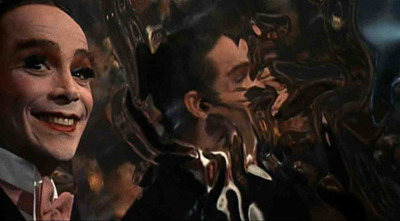
First impressions are so important, right? And by logical extension, so are opening numbers. No discussion of these is complete without mention of the sexy and surreal "Willkommen" from Cabaret, the highest ranking adaptation of a stage number on this list.
Joel Grey is sensational. This is not the kind of performance that wins Oscars, except that it did, and in doing so trumped a gaggle of Godfather goons, Under any other circumstance, that would have earned Grey the scorn of movie history, but his MC is one of the defining characters of 70s cinema, and even to the detractors, the win is not as egregious as it may seem. Personally, it's one of my favorites in the entire category.
But things are not as they seem: this number is a two man show. Grey's magnetic weirdness has us at hello, but Bob Fosse's staging of the whole spectacle is no less memorable. Grey had previously won a Tony for this very role. but from the opening reflection, we can tell we're not in for a standard stage adaptation. The camera never settles into place, while the editing exposes every nook and cranny of the Kit Kat Club (exactly what you wanted to picture, I know). There no better example of a musical adaptation moving beyond the theatrical and into the cinematic than Cabaret, and it is first in "Willkommen" that we understand what kind of a ride we're in for.
And now for something completely different:
4. "Haan Jab Tak Hain Jaan" from Sholay
Everything about Sholay is downright mythic, the essence of the American western cloaked in the guise of a Bollywood musical. Heroes, anti-heroes and villains loom larger than life, and from early on it's perfectly clear that this is a battle of white hats and black hats. Unlike so many American westerns, however, Sholay succeeds in making its leading lady no less fascinating than the boys.
"Haan Jab Tak Hain Jaan" comes well into the film's roughly 3 hour run time. After the hero has been taken captive by Gabbar (who is one bad dude), his lover Basanti is offered the chance to prolong his execution, so long as she continues to dance. Rarely has Bollywood needed a reason to launch into a musical number, but never was there a more opportune time than here. Her song is a plea of love and desperation, and one of the most beautiful numbers I've ever witnessed on film. Her dancing, nothing short of mesmerizing.
Then Gabbar and his bandits up the anti, smashing bottles and scattering broken glass across the ground. The dance for life itself becomes a dizzying fight of perseverance for Basanti, bleeding all across the dust, her strength rapidly failing her. Everything about the number exists on such a grand scale, with love and devotion and justice all at stake in a battle of good vs. evil. What makes it all the more special is the realization that this is what art and entertainment in the world of globalization can achieve: a distinctly Indian movie that nonetheless owes a debt to American cinema, across multiple genres no less. Then again, I could reduce the discussion of this song's merits to the hypnotic movements of Ms. Malini and this would still be deserving the estimable rank of fourth on this list.

I'm gonna have to ask that you take my word on this one. You'll notice the lack of video above. I did provide a youtube link, which offers a nice prelude, but that's maybe a third of the whole song if that, hardly enough to justify its rank as the third greatest movie musical number of all time. I would say youtube dropped the ball on this one, but the likelier culprit is society's waning interest in classic film. There's no good excuse for a masterpiece like Footlight Parade to be falling through the cracks. The clip above may be enough to pique your interest (if "By a Waterfall" hadn't already), but this is one you'll have to seek out on your own.
Lament over. Here's the substance. I think it only appropriate that one of the first great musical numbers in movie history would be directly inspired from the number one box office hit of the year before (that film is Sternberg's Shanghai Express, and it is marvelous). That is, of course, merely what enticed me to Footlight Parade in the first place, and the number itself, which closes out the film in spectacular fashion, is anything but an homage. It starts with the brilliant lead in of the multi-talented James Cagney literally falling into a musical number, where he promptly assumes the lead role. That's a pretty grand entrance, wouldn't you agree? It only gets better, moving along from a familiar bar song to a rousing dance routine before coming to a head in a triumphant march, all set to one of the catchiest songs in Hollywood history. Alas, I'm stranding you without proof on this one, but if you consider yourself an advocate for this strange and improbable genre, then you'll be wanting to catch up with Footlight Parade sooner than later anyway. When you do, kindly remedy this little youtube travesty for me.
Never has one man expended so much energy in such a short space of time.
The titular song of "Singin' in the Rain" gets all the credit, but nearly any fan will point to "Make 'Em Laugh" as the film's signature track. If Donald O'Connor's reckless abandon can't make you a believer in the power of musicals, then there is literally no hope for you, and your very existence has already ceased to interest me. There's a hint of desperation in the performance here, the kind where one man throws literally everything he's got against the wall and hopes it will stick. Sometimes it does, sometimes it doesn't, but mostly, it just crashes right on through. That's the moment you realize you're in the company of greatness.
Best of all though is the song's function as a whacked-out defense of the entertainment industry, one which neatly sums up the role of musicals in general. It's not strictly about laughter per se, but there is definitely something to the saying "give the people what they want." This number is the beating heart of a movie that's a fantastical celebration of show-business, and a love-letter to those who've fallen under its spell. To watch O'Connor run amok here is to completely forget oneself if only for a moment, and that is the kind of escapism that entertainment at its finest can offer. Even such a skeptical film viewer as myself can appreciate that sentiment. To bask in the hilarity of "Make 'Em Laugh" is one of the great wonders of cinema.
1. The Ballet from The Red Shoes
A relentless excursion into the dreamspace that exists at the crossroads of artistic modes of expression. This is equal parts stage and sound and dance, packaged in a way that could be described as nothing but cinematic. Don't let the drawing of the curtain fool you, no traditional staging could possibly replicate the wonders of The Red Shoes and its central ballet. Yes, this is a musical number. No, there's really not anything else quite like it. If it stands a measure apart from the other entries on the list, that's only because it belies comparison. This, friends, is the genuine article.
It shares all the essential ingredients of the other musical numbers ranked before it. The star of the show, Moira Shearer, turns in a transcendental performance, her hair afire as she dances from backdrop to backdrop, confronting her demons both onstage and off. There are elements of surrealism at play here, but the influences are more firmly rooted in artistic mediums than anything else. Only through the magic of movies is such an onslaught of art and dance and music possible. Time falls by the wayside as one image merges with the next, with Shearer's intrepid Victoria Page commanding every frame with her effortless poise.
This could only be the work of The Archers. No directors, save perhaps Peter Greenaway many years later, can boast a grander commitment to the assessment of the place other artistic mediums have within cinema. The Red Shoes ballet is a summation of their devotion to this subject, and within these frames the cinematic artistry knows no bounds. The camera itself might a well share a billing as it grants us access to angles of the stage we would never be privy to, and the hypnotic effects owe directly to the hand of a master editor. The tricks are little different than the other landmark musical numbers, but the illusion burrows miles deeper. We're I a man prone to hyperbole, I would call this more than the greatest musical number of all time, I'd decree it the greatest scene ever captured on film.
But of course, I am a man prone to hyperbole, and so I will pronounce with significant enthusiasm that art simply doesn't get any better than this. And on that bit of extravagance, it's time to bring this spectacle to a close. Good night. See you next month.


