Friday, July 16, 2010

Top 100 Films - #14

14.

Too often reduced to categorization as American theater reworking of 8 ½, All That Jazz doesn’t need likening, however favorable, to that Italian masterwork to make a case for its greatness. Joe Gideon, the overworked choreographer and director, who like Guido is defined by the women in his life, also bears striking resemblance to his creator, the legendary Bob Fosse, and the fascinating psychosis of the source material imbues All That Jazz with one of the richest protagonists in Hollywood history. Roy Schieder plays Gideon – one of the greatest turns ever recognized by the Academy – and breaths life into the mad genius by showing his dreams and obsessions, his vices and vulnerabilities. He’s hampered with more than just creative block; Fosse saddles Gideon with a death drive that not a decade later finally caught up to him in reality. Schieder plays him like a force of nature, and that’s the only reason we believe him brazen enough to spit in the face of another force of nature, mortality, as he does throughout the film.

All That Jazz is staged as a battle Gideon cannot win, but that’s hardly for lack of trying. As he burns himself out, his erotically charged musical numbers move straight to his mind, where they become even grander than they were at the theater. He immerses himself in these fantasies up to the bitter end, and Fosse marvelous contracts the vibrant backstage world of his dreams with the bleak reality of hospital rooms. He meets death practically dancing on his own grave, which may not be winning, but as far as big exits go, it sets the bar exceedingly high.

It’s also the peak of an entire genre. Fosse removed frivolity from the musical, something that was really wearing on the medium by the late 60s. There was more to this than merely confining songs to the stage, as Cabaret does. All That Jazz makes use of all variety of musical numbers, from choreographed dance on stage and in the rehearsal room, to the lovingly executed routine Gideon’s daughter and girlfriend leap into at his apartment, to the impromptu grand song and dance numbers recalling everything from Busby Berkley to disco that string together the final days of his life. Firmly grounded in the genre, yet stripped of all its worst tendencies, All That Jazz may actually be the most palatable musical out there, and if nothing since has come close to its brilliance, they can be forgiven. Like I said, tough act to follow.

Thursday, July 15, 2010

Top 100 Films - #15

15.

The uncanny score and the deeply hued palate set you on edge, but it’s the brutal double-murder extravaganza that kicks off Suspiria that cements its reputation in horror movie history. Following the impeccably executed first ten minutes, Dario Argento could have finished the rest of the film in his sleep and it would still rank among the best of the genre. Thankfully, he doesn’t, and though Suspiria could fairly be accused of blowing its wad prematurely, the spectacle of the opening scene undeniably gets your attention. It’s probably for the best that Argento never tries to trump the sanguine theatrics of the opening ceremonies, instead perfecting his particular brand of horror that ebbs between moody exposition and hyper-stylized slaughter.

And yet death is not taken lightly in Dario Argento films. Whereas most horror films casually and expediently dispatch with their red shirts as a means to build momentum and create cheap thrills, he gives his victims star treatment. The murders in Suspiria are few and far between, but each is staged as its own baroque set piece. The second I’m particularly fond of, a midnight stroll through an empty town square that seems destined to go horribly wrong, the pulsing question being how? There’s no sense in spoiling the fun of it all, but it quite literally leaves a mark, and if you haven’t already, you get the feeling that it’s an honor to die in an Argento film.

Top 100 Films - #16

16.

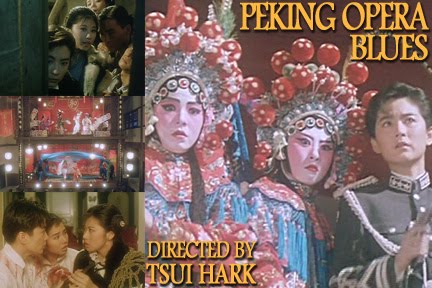
The greatest spectacle to emerge from the Hong Kong film renaissance was Tsui Hark’s manic Peking Opera Blues, an unlikely love letter to both Chinese theater and American slapstick, carried on the capable shoulders of its three female leads. The film is a zany rollercoaster of multi-genre thrills and might find its closest comparison to a live-action Loony Tunes episode, a none-too-easy feat that Hark can claim credit for thanks to his unrelenting pace, innovative incorporation of the bric-a-brac, and increasingly outlandish set pieces. Early 20th century Peking gets recreated as a virtual playground for the actors, who may just be having as much fun as the audience is amidst the colorful costumes and escalating political intrigue. Notably, it situates three women at the crux of the hijinks; a general’s daughter (Brigitte Lin), a woman on the hunt for stolen jewels (Cherie Chung), and an aspiring performer stubbornly resisting the male-dominated composition of the Chinese Opera (Sally Yeh). Such characters are refreshing even to this day, when the offering of savvy action heroines is not much better than it was a quarter century ago. To top that off, they also form a sort of ragtag team, each bringing their advantages and proving not only can you have a female-action-type, you can have at least three.

If only such wisdom could have proved more influential. Peking Opera Blues does everything so well, and so right, that it’s a wonder it doesn’t have more imitators. Not that replicating Hark’s insane plotting would be anything-but hazardous to one’s health, but merely that movie spectacles can flourish as women take the reigns, and that films can carry themselves with intelligence without sacrificing thrills, laughs and pure joy.

Wednesday, July 14, 2010

Top 100 Films - #17

17.

Fellini, fresh off the international success of La Dolce Vita, could have made the film of his dreams, and in a way he did, but the spectacular vision of 8 ½ that seems to have sprung fully formed from his head defies conception, design, premeditation. It arrives at the summit of Fellini’s career, everything before building steadily to this fantastic event, everything since pursuing that actual film of his dreams, which like that of any director, is chock-full of self indulgence (not necessarily a bad thing, but in his case usually so). 8 ½ holds everything in perfect balance, his carefully cultivated sense of style, his elegant yet rapid-fire rhythm, as romancing as the language itself, and his inevitable full embrace of the fantastical elements present in small doses throughout his earlier work. It exists, I suppose, because in the wake of La Dolce Vita, a career high by almost any standards, Fellini didn’t have a dream project, just a muddle of ideas concerning where he came from and where he was going. What arose from the clutter was unique to cinema, a telling exposure of the creative process from a director liberated of any need to prove himself, yet entirely concerned with analyzing his own place in things. Few films that feel so personal also feel so adventurous, and 8 ½ embodies everything so exciting about the rise of auteurs and foreign cinema in the early 60s. It remains equally awe-inspiring today, and among the films frequently cited as the greatest of all time, it stands as one of the few where I fully, wholeheartedly, perhaps fanatically, buy into the hype.

Wednesday, June 23, 2010

Top 100 Films - 18

18.

No way can I write about The Big Heat without exposing a few of the great surprises it holds in store, so be warned, there be spoilers ahead. In fact, it’s a significant film, both for me and for cinema in general, in part because of these moments, which whether in or out of context of the era are profoundly shocking. It looks at first as if Fritz Lang is overplaying the American dream as Dave Bannion’s adoring wife fauns over him as he comes home from work, but that makes it all the more shocking when he blows that dream (and the car, and the wife) to smithereens, raising the stakes mighty high early on and giving Bannion every reason in the world to pursue justice by any means necessary. The car bombing is unique in film noir as it’s a personal assault of a nature that’s not previously been seen. Sure Sam Spade loses his partner Miles Archer at the outset of The Maltese Falcon, but their bond is professional at best and we never think that Spade could be deeply affected by the loss of anyone, whereas family man Bannion becomes a loner only when that which he loves most is ripped away from him. In a genre that thrives on the emotional distance of its leading characters, The Big Heat is the rare film that gives us a reason for such a lifestyle.

Yet even after that explosive first act, it’s hard to brace yourself for what’s to come. The legendary hot coffee scene, in which Lee Marvin’s brutal gangster scalds and disfigures his brazen girlfriend Debby, played by Gloria Grahame, surely must be the most raw act of sadism to occur under the guise of the Production Code. It strikes a nerve, and if In a Lonely Place weren’t enough, seals Grahame’s reputation as noir’s great tragic figure. Like Bannion she’s damaged, in her case physically as well as emotionally, and it’s not hard to see what draws them to each other. Their alliance seems a perfect one, but Debby fights with the reckless abandon of a woman with nothing left to lose while Bannion must consider the safety of his child. It’s ending seems inevitable from a mile out, but impending doom becomes easier to swallow when taken with sweet revenge. Lang remains unflinching to the very end, capping of a showdown of primal intensity with a most mundane scene of Bannion back at the office, presented with the blisteringly ironic offer for a cup of coffee.

Top 100 Films - 19

19.

For a while when I was first getting acquainted with Jean-Luc Godard, every film of his I would watch would become my new favorite. I think I bounced from Breathless to Contempt to Masculine Feminine to A Woman is a Woman before Pierrot Le Fou put an end to the cycle, but I wouldn’t balk at any claim of one of Godard’s unbroken run of 60s masterpieces as a personal favorite. But Pierrot is for me the definitive Godard film, a Bonnie and Clyde tale that reverses Jean-Paul Belmondo’s role from Breathless, instead stringing him along as the companion in an escalating crime spree. It also features Raoul Cotard’s finest work as cinematographer, give or take Contempt, the evidence lying both in the scenic Mediterranean landscapes and the intimate soul-capturing close ups that allow the two legendary star to let loose before the camera. Godard is at the height of his powers here, brandishing a sense of play that waned as his films got increasingly political. It’s a relentlessly fun ride, and with Anna Karina’s uncompromising allure, one of the sexiest films of the swingin’ 60s. The ending, as only Godard could manage, goes out simultaneously with a whimper and a bang, a deeply satisfying (and deeply hued) conclusion to one of the greatest road movies ever.

Tuesday, June 22, 2010

Top 100 Films - 20

20.

I was late to the Lebowski party, having somehow carried on an existence without it up until my freshman year of college, when I first joined the Dude, Walter and Donnie on their neo noir odyssey across Los Angeles. Over the next 12 months, I lost track of how many times I revisited this, compulsively converting new followers and experiencing it on a whole new level over many a delicious White Russian. It wasn’t until sometime later that I was able to get over my cult like fascination with the movie and do something I never thought to do – take it seriously.

And I don’t mean to suggest that The Big Lebowski should be so burdened with analysis that it becomes impossible to kick back and watch the hilarity of it all ensue. But dammit, this is a brilliant film, delivering nothing short of comic gold while adapting the trickiest of genres – noir – to the slacker culture of early 90s Los Angeles. When Jeffrey “The Dude” Lebowski’s rug is soiled after a case of mistaken identity, he embarks on a quest for reimbursement that spirals into a convoluted Raymond Chandler style plot that deceptively drives The Dude further off course as the clues, characters and car troubles escalate to the extreme. So it’s a neo-noir comedy, but it also takes cues from Westerns (hence the presence of Sam Elliot in cowboy gear) and Busby Berkeley musicals (The Dude’s porno hallucination) and you could even argue it’s a historical piece (set against the backdrop of The Gulf War). The cast consists mostly of memorable cameos, oddball characters that drop in to make The Dude’s life more complicated only to prove unimportant no matter which way you look at things. But for that we get Ben Gazzara as slick porn mogul Jackie Treehorn, David Thewlis as the literally hysterical Knox Harrington, Joe Polito as meddling snoop DaFino, and John Turturro as the one and only The Jesus. Even the more significant supporting players – Julianne Moore as the icy Maude Lebowski, Phillip Seymour Hoffman as loyal lapdog Brandt, the band of nihilists lead by Peter Storemare – prove nothing more than diversions from the real solution. But then again, if all these characters don’t really factor into any grand scheme, at least they provide The Dude with a reason to get out of the bowling alley, and in one case, out of the bathtub.

I can’t believe I’ve gone so far without singling out Jeff Bridges, but he embodies The Dude like only an actor of his ease could do, and truly he’s what ties the film together. Playing perfectly off his passive approach to life is John Goodman as bowling buddy and ‘Nam vet Walter, and along with their more diminutive teammate Donnie, they form the core of the movie, with the bowling alley being the one constant in The Dude’s suddenly upturned life. In that way, the film does set itself apart from noir, for although The Dude is as unlikely a hero as there ever way, he has his close friends, who despite their flaws, are there with him to the bitter end. And ultimately, as the film draws to a close, we understand at last that those are the bonds that mattered the most to The Dude, and this whole charade that started with one ruined rug wasn’t worth one night in the bowling alley.